
Home » Newsroom Posts » How Hospitals Can Improve Workflow Efficiency with Shared Communication Devices

June 1, 2026 | Henry C. Senturia
10 minute read
TL;DR: In Japanese hospitals, nurses often use shared devices, which when coupled with nurse call servers, creates a disconnect between a nurse’s personal phone extension and their assigned patient nurse call extension. To solve this disconnect in communication, nurses could log in with their personal extension when they obtain their phone at their assigned nursing station. This improved shared device solution is a better option than alternative solutions because it has lower consequences from user error, lower cost, more redundancy, and keeps devices linked to the same zone regardless of a nurse logging in or not, decreasing the likelihood of losing a device in transit between nursing stations.
A night-shift nurse hears a chirping ringtone from her smartphone—a patient nurse call. This particular ringtone means the call is a general nurse call, not an emergency. The nurse has her hands full with another patient, both figuratively and literally, so she doesn’t pick up the line. Because of the unique ringtone for each type of call, she knows that she won’t be ignoring an emergency and can safely let another nurse in the area handle the patient’s call.
Out in the hallway, one of the other nurses assigned to her zone picks up the line. Her phone rang simultaneously—as did every phone carried by a nurse assigned to this zone’s nursing station. She’s available and she’s closer to the patient’s room, so her response time is faster. And, she doesn’t have to walk as far, which means less physical stress for her. Nurses walk a lot. A study presented in the Journal of Biomedical Informatics tracking the activities of nurses on shift in a 308-bed oncology unit found that that nurses were traveling anywhere between 3 and 10.5 miles per 12-hour shift.
When the available nurse picks up the phone, everyone else’s phones stop ringing and the nurses all know that someone has taken the call. There is one major issue, though—there’s no easy way to know which nurse took the call or when the call took place. The nurse call extension that the smartphone uses is separate from the nurse’s personal extension since the phones are shared devices, used by different nurses as shifts change. Staff who want to get in contact with the nurse who took that nurse call have to look up what nurse call extension she’s using during this shift, referencing a shift schedule or something similar.
The smartphones that the nurses in this story use are great for uniting their communication needs onto a single device, but, as is usually the case in Japanese hospitals, the devices are shared. Each shift, nurses are assigned to a specific location, usually called a “zone,” where they receive smartphones linked to that zone’s nursing station.
This system is a consequence of the way that nurse call servers operate in Japan—they can only ring a limited number of phone extensions, usually referred to as nurse call extensions, which are not easily changed. The smartphones linked to a particular nursing station are already connected to the right extensions for the nurse call system in that zone. However, this means that nurses using these shared devices are using a random extension number each shift, hindering effective communication between staff. Communications like push-to-talk (PTT) transmission, chat messages, and extension calls are less efficient than they could be—the person receiving the PTT transmission, chat message, or phone call doesn’t immediately know who’s contacting them because the shared smartphones aren’t linked to a staff member’s personal extension.
The primary issue at hand is the disconnect between a nurse’s personal extension and the nurse call extension, which means that there isn’t an easy way to identify who is communicating on the other end of a PTT transmission, chat message, or extension call. One way to solve this issue is to assign smartphones to nurses that they bring with them to new assigned locations across shifts—an “assigned device” solution to the problem. This means that nurses can easily identify who is messaging them, calling them, etc., but they must log into a nursing station when they arrive to their assigned location in order to receive a nurse call extension.
The other way to couple a nurse’s personal extension with a nurse call extension is to keep the existing system with shared devices that return to a nursing station in between shifts, but allow nurses to log into those devices with their personal extensions when they pick them up at the start of a shift—a improved “shared device” solution to the existing disconnect in communication. Here’s what the flow of each of these solutions look like:
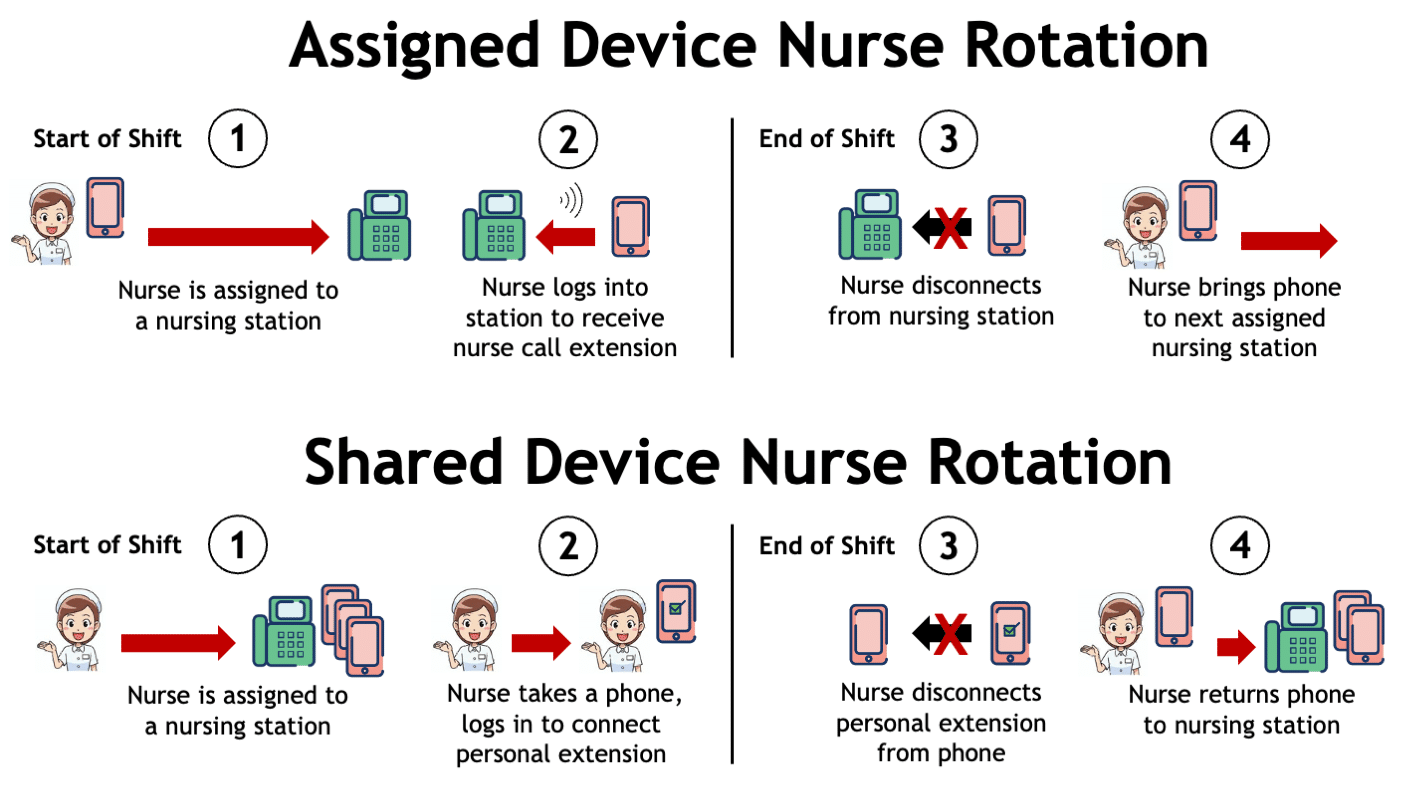
A brief analysis of each approach should make clear that the shared device approach is the better choice, for several reasons. The most important distinction between these two approaches lies in the consequences of user error, e.g. a nurse forgetting to log in. In the assigned device scenario, forgetting to log into a nursing station means that the nurse won’t be able to receive nurse calls. She might be left scratching her head wondering why her phone is so quiet, while patients wonder when someone will answer their call.
Conversely, in the improved shared device scenario, even if a nurse forgets to log in with her personal extension to a shared device, she will still be able to receive nurse calls. The consequences of user error are far less serious using the improved shared device approach since the user error case just means that the nurse operates the way she currently would—with a disconnect between her personal extension and nurse call extension.
User error is important to consider because it will happen, especially considering the high-stress, high-distraction environment medical staff work in. A study of emergency physicians found that they were interrupted or changed tasks more than 50 times on average over the course of 3 hours. Interruptions translate into forgotten tasks, and habitual tasks like logging into a nursing station are easily forgotten when facing interruptions. Only 48% of people participating in a study on interruptions were able to remember to resume their previous task instead of proceeding with other tasks after an interruption. In healthcare, a fail-safe solution is necessary to prevent a staff members’ gaps in memory from impacting the well-being of patients, and the improved shared device solution provides that fail-safe.
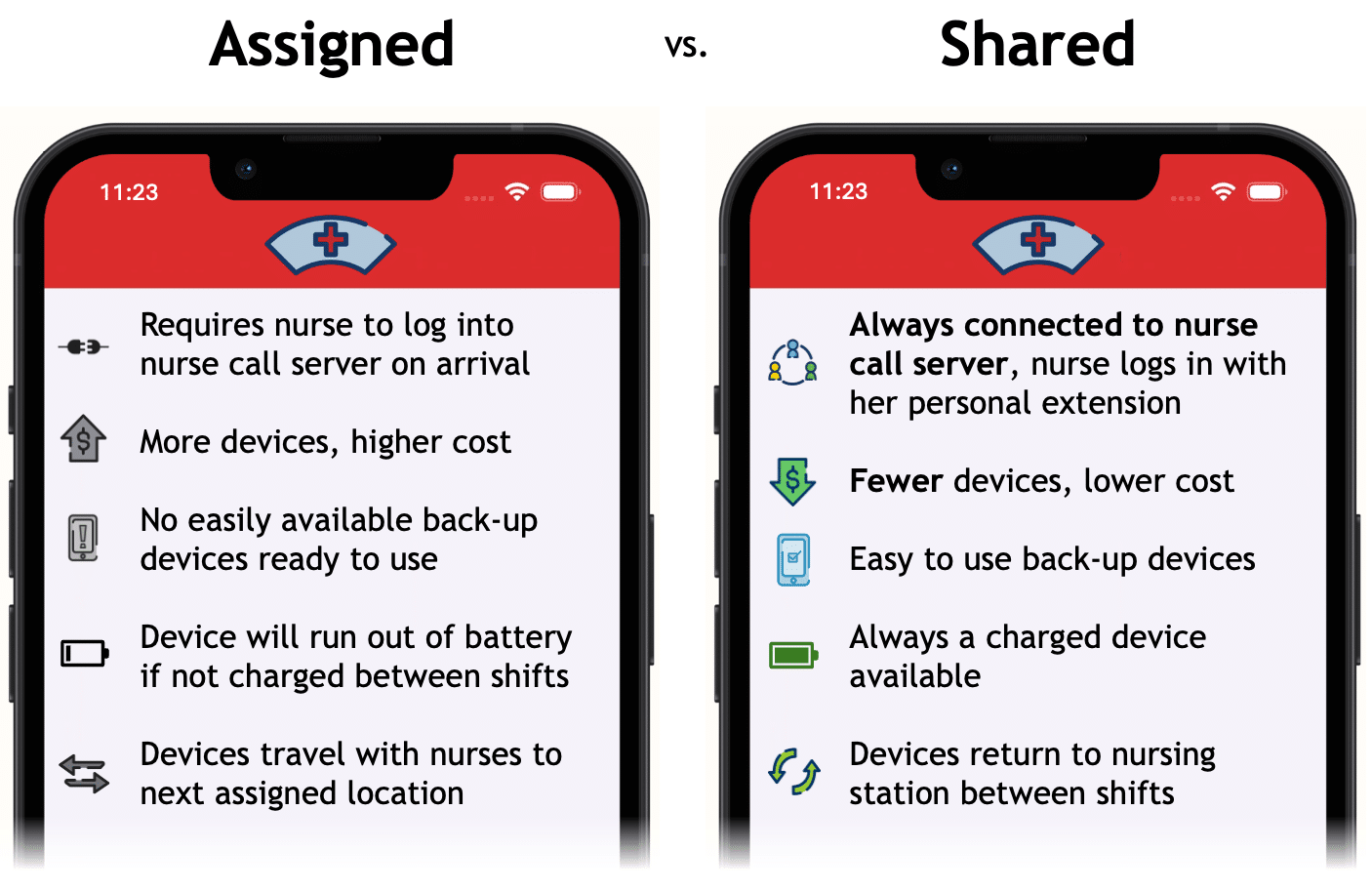
Here’s a look at some of the other benefits of an improved shared device solution over making the switch to an assigned device solution:
While outside the primary focus of this article, there a number of other communication challenges that hospitals face in their daily operations, including:
These common issues also present good targets for further optimization. Get in touch with us today to tell us about the communication challenges you experience in your organization.